
On the unreliability of perception, identity, and self-knowledge.
I want to talk about what happened after things went silent—about how, after I was hospitalized and treated, I had to face the brutal reality looking me in the eyes. My ego had been inflated so much because I listened to the voices—to the flattering insinuations. And then there were the strong threats that invoked paranoia. The dissociation from life made the fall from psychosis harder. When I went without medication, the voices grew louder, and my first hospitalization led to a misdiagnosis. Two or three years later, I was diagnosed correctly. That was in 2021. My first hospitalization was in 2018.
Maybe I must mourn the grand person I made myself up to be. Maybe I should look into who I really am. Maybe that person is more ordinary than I thought.
But even still I can’t figure out the person that I am. I can’t find many people who can. Maybe I’m making progress. Maybe I’ll know more than most people because I have had experiences. But experience is subjective. I can recognize that reality is distorted through my perception. There is no perfection.
Schizophrenia discombobulates the victim’s mind. It turns the mind into a compass that is unreliable. Wherever I want to go, it takes me elsewhere. Whatever I intend to accomplish, the compass misguides me. It opposes the forces that man intended it to measure. I know I am of less use to most people, as a disabled person. But I am doing my best to make the world a better place by sharing what I have.
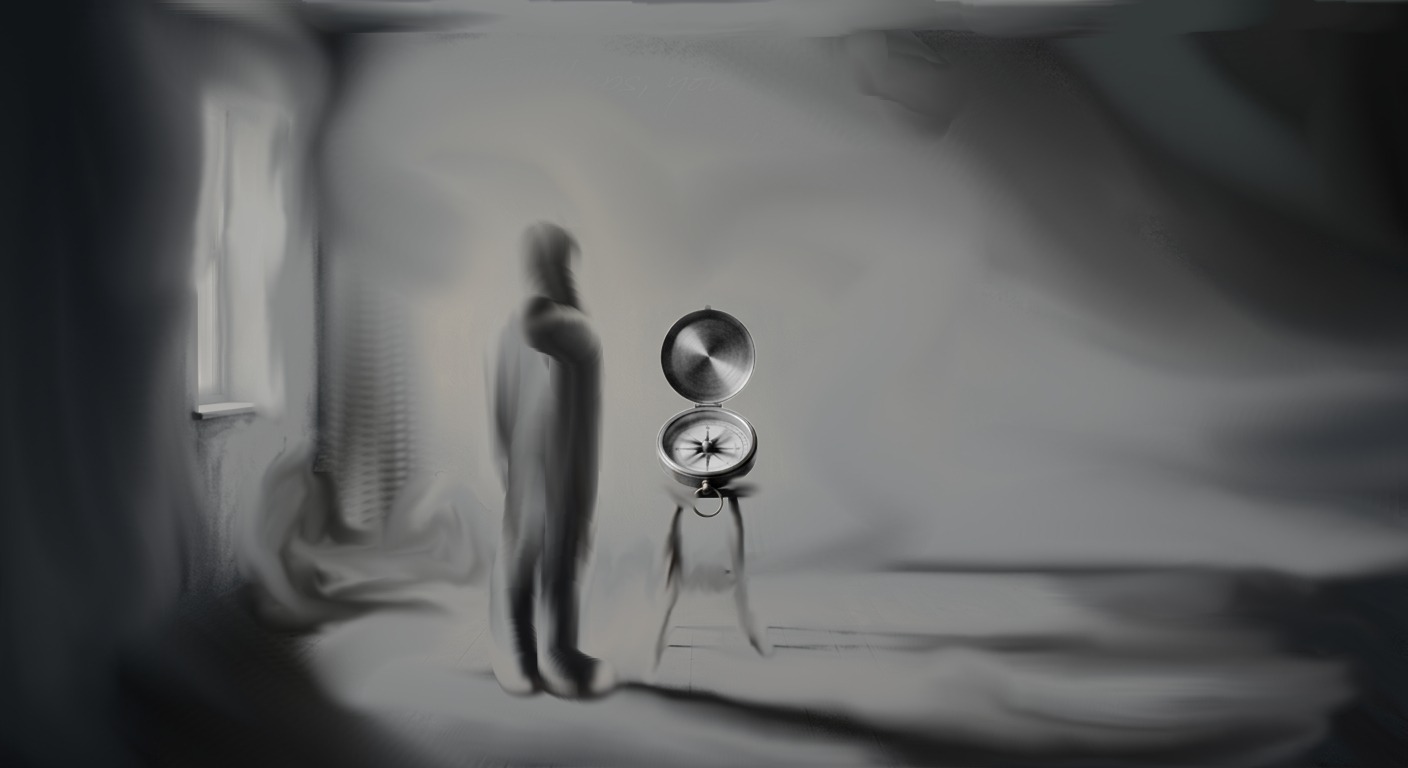
I think I was more confident of who I was when I was younger. After going mad for years, I’ve lost my identity. But I’ve thought about what makes up our identities, which taught me how we can be lost. We can have false identities, even if we don’t know it.
I have my wild thoughts. I have my false beliefs. I have a weak metacognition. I have a false identity that eludes me. And then I have volatile emotions that make me a loose cannon. What can I do?
No, I have none of that. I have uncertainty. I am certain of that. I am certain that no matter what we do, a human being can not know everything at once or in one lifetime. I am like you. I am ordinary. Perhaps, you are grand.

When joined with another purpose becomes clear.
Are you saying that having purpose clears up the chaos?
Yes …. not it alone, but the fellowship it provides in peacefully facing life’s changes and challenges goes a long way in lighting the lanterns we need to make it through the darkness …. it’s a beginning …. man becomes lost in the darkness by not accepting the responsibilities of fellowship …. the prospect of liberty from this responsibility is the dark light radiating from Lady Liberty’s torch … America has got it wrong . . . .
You write well, but I can’t fight corruption.
The why prophet said to to run for the hills when you see these things
And where is the hills?
Better said mountains. Away from the cities.
When I was in College, and I read Christopher Lasch. By now, I depend on AI to summarize his work. However, the majority defines normal. It is not a voting game; it is a consensus of shared perceptions. I have gone through episodes of grand mal depression and surely some madness. I have not hurt anyone, except possibly myself. But I am also still here. Here, of course, is a relative perceptual matter, so I see a lot of relative madness around me.
Is what you write useful? Of course it is. All that we produce is, even if no one ever reads it. And that we will never know. Writing is cathartic. If you would not do it? Where would your ideas go? Write because you never know who or what you will inspire, including yourself.
Google AI
Christopher Lasch’s 1979 book The Culture of Narcissism argues that American society has shifted from traditional individualism into a pervasive culture where psychological narcissism is normalized.
EBSCO
+1
Core Thesis
The New American Character: Lasch argues that modern social structures turn people inward. Instead of classic self-reliance, the modern person suffers from inner emptiness and fragile self-esteem.
Dependence on Validation: The narcissistic individual relies heavily on external approval and expert advice rather than personal moral authority.
Survival Retreat: Faced with a sense of powerlessness over large political and economic issues, people obsess over self-image and personal survival.
Key Cultural Themes
The Therapeutic Shift: Society replaced traditional religion and community with a focus on therapy and self-awareness. People chase the temporary illusion of psychic security rather than collective progress.
mbird.com
+1
Consumerism and Spectacle: Mass media and consumer culture promote immediate gratification and turn human relationships into shallow commodities.
The Evisceration of Authority: Traditional family structures weakened as parents abdicated their roles to child-rearing fads, State agencies, and therapeutic professionals.
Thanks Michael. You are absolutely right, and your words, “Is what you write useful? Of course it is. All that we produce is, even if no one ever reads it,” inspired me ever since I read this comment.
Your source is also very interesting. I will take note of him. Again, thanks. 🙏
Thank you. One writes for oneself and for the person who takes the chance.